




Our Lovable review verdict: Lovable is worth it if you're a non-technical founder who needs a working web app fast, and $25 a month (or about $21 billed annually) buys enough credits to build and test a real first version. It gets harder, and more expensive, once the app has paying users, because credit costs creep up, fixes cause regressions, and database security rules, SEO and code ownership become your job.
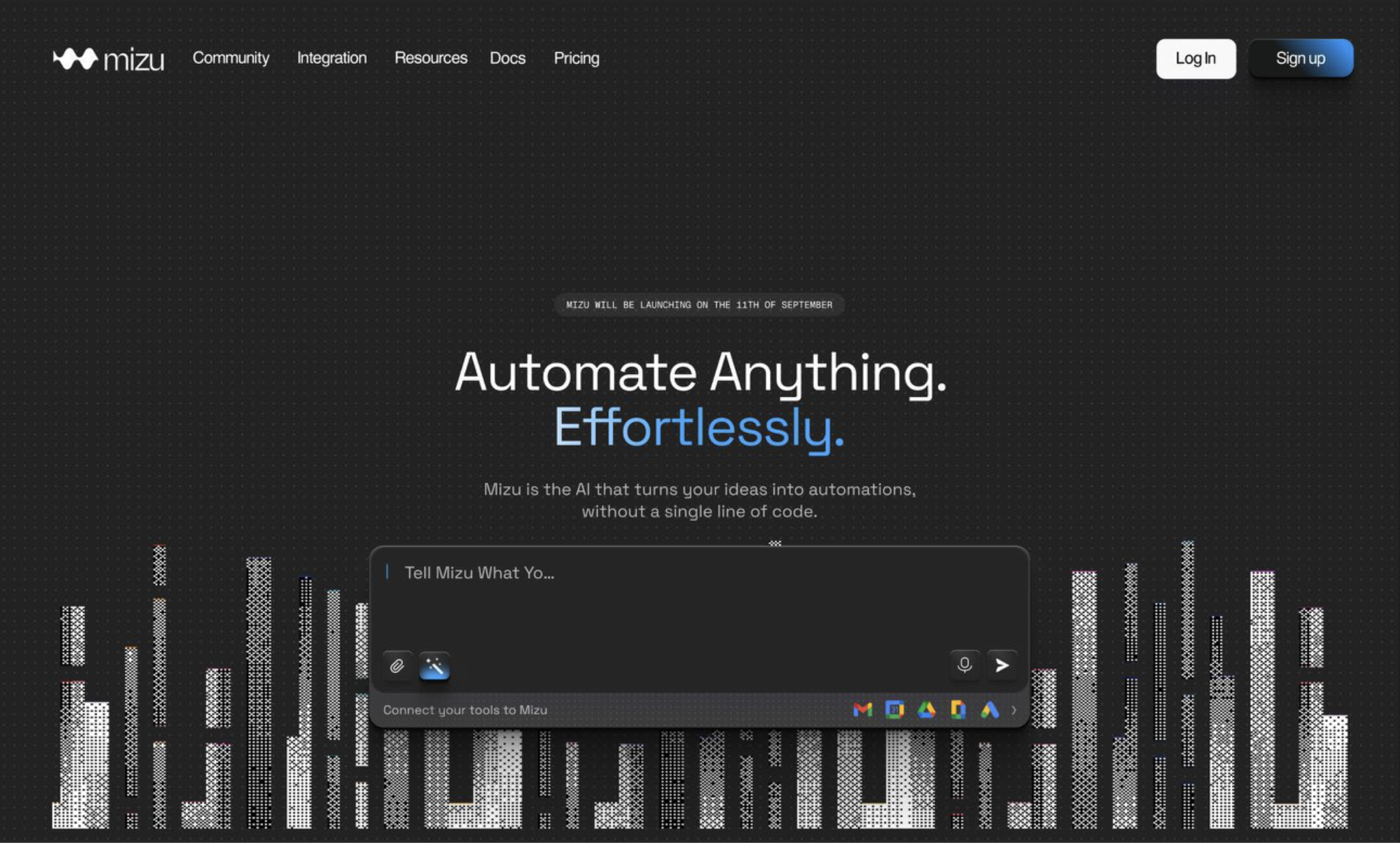
How we reviewed it. We're a product studio that builds React and Supabase apps for founders, the same family of stack Lovable generates, and we've built products in the AI-builder category ourselves, like Mizu AI, an automation builder we took from zero to launch in 6 weeks. We haven't shipped a client project on Lovable, and we didn't run our own test build for this page. This review is built from Lovable's docs and pricing (rechecked on October 6, 2026), its own security disclosures, funding reports, and what long-term users report on Reddit and Hacker News. We also sell custom builds, which comes up once near the end, so read that part knowing our bias.
| Your stage | Is Lovable worth it? |
|---|---|
| Idea, no users yet | Yes. Start on Free, move to Pro 100 when the 30 monthly build credits run out. |
| Validated, first users testing | Usually yes, if you check database rules, keep projects private and sync to GitHub. |
| Paying users, growing product | It depends. Many teams keep Lovable for hosting and move the actual coding to a developer or a coding agent. |
| You can code | Probably not as your main tool. A code editor with AI gives you more control. |
What is Lovable?
Lovable is an AI app builder: you describe what you want in a chat, and it builds a working web app, with hosting, a database and login available through Lovable Cloud. It launched in November 2024. By its own count, users have created more than 60 million projects, and apps built on it get more than 900 million visits a month, per TechNode.
Is Lovable legit?
Yes. In August 2026 Lovable raised $400M at a $13.3B valuation, co-led by Menlo Ventures and EQT, more than double its December 2025 valuation of $6.6B. It isn't going anywhere soon. "Legit" and "safe for your data" are different questions, though, and the second one has a real history, covered below.
How much does Lovable cost?
Lovable has four plans: Free, Pro from $25 a month, Business from $50 a month, and custom-priced Enterprise. Pro and Business are sold in credit tiers, and annual billing gives you two months free.
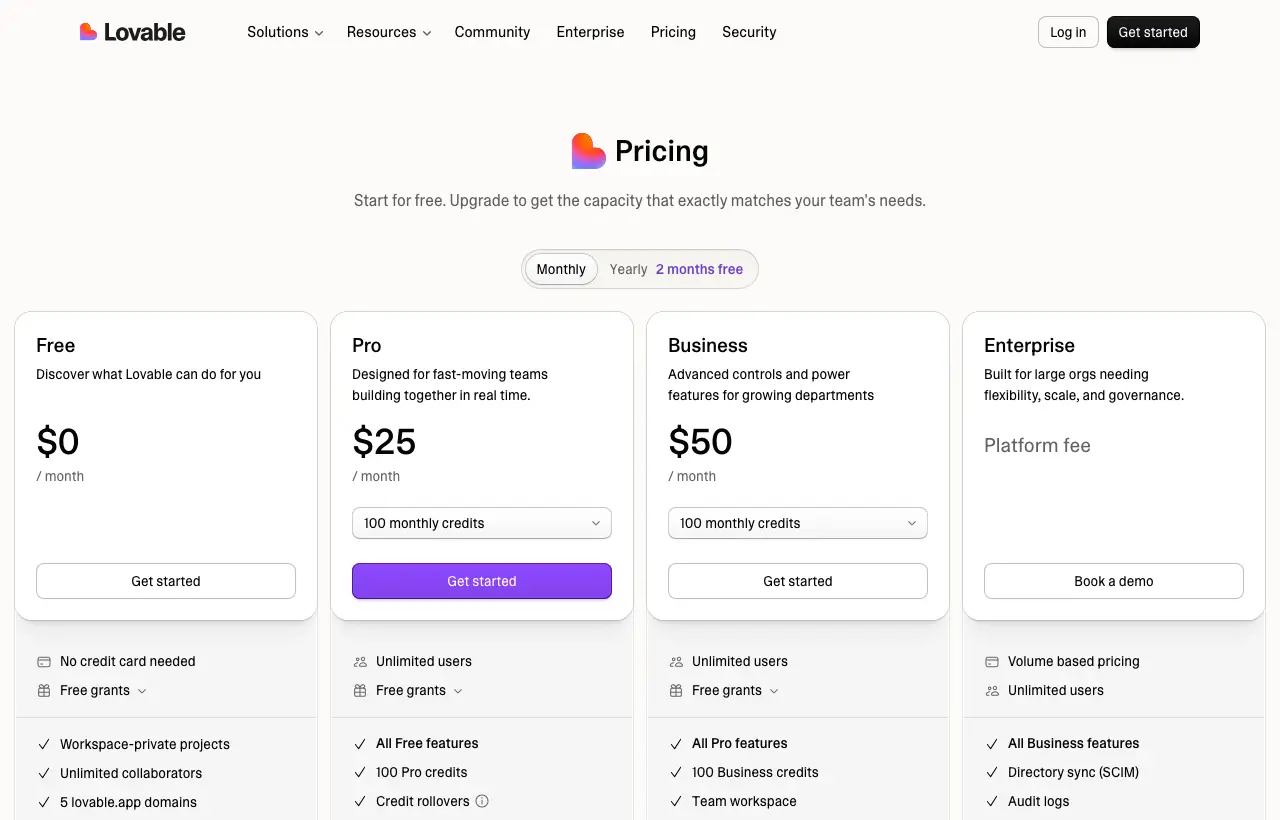
| Pro credits per month | Monthly | Annual (per month) |
|---|---|---|
| 100 | $25 | $250/year (about $21) |
| 200 | $50 | $500/year (about $42) |
| 400 | $100 | $1,000/year (about $84) |
| 800 | $200 | $2,000/year (about $167) |
| 2,000 | $480 | $4,800/year ($400) |
| 10,000 | $2,250 | $22,500/year ($1,875) |
Prices rechecked on October 6, 2026, from Lovable's subscription plans docs, which list more tiers in between. Business starts at $50 a month for 100 credits and adds SSO, a security center, role-based access and workspace data excluded from AI training by default. On Free and Pro you opt out of training yourself.
What the free plan really gives you. Free includes 5 build credits a day, capped at 30 per calendar month, so if you build daily you use the month's allowance in the first 6 days. Free projects can't have their code edited or downloaded, can't use a custom domain, and keep the "Edit with Lovable" badge. GitHub sync and private projects do work on Free, which is more generous than most builders.
How credits actually burn. One credit pool pays for building, chat, Cloud hosting and backend, and AI features inside your live app. Lovable's credits docs give example costs:
- "Make the button gray": 0.50 credits
- "Remove the footer": 0.90 credits
- "Add authentication": 1.20 credits
- "Build a landing page with images": 2.00 credits
Stopped requests are still charged for the work done. Unused monthly credits roll over but expire 2 months after they're issued on monthly plans. Chat is currently billed per message with a daily allowance, an offer Lovable says runs through October 31, 2026, so check the docs if you're reading this later.
The worked math. On Pro 100, a credit costs $25 ÷ 100 = $0.25, or $250 ÷ 1,200 = about $0.21 on annual billing. The tiers scale in a straight line up to 800 credits ($200 ÷ 800 is still $0.25), so buying a bigger tier doesn't buy cheaper credits until 1,200 credits and above. By Lovable's own example, one landing page at 2.00 credits costs about $0.50. A real project costs far more, because most credits go to the hundreds of small changes and fixes after the first build. One user who shipped a full project put the honest range at "hundreds to complete if not a couple thousand", and was happy with the trade: "We spent less than 1k on a project that probably would have taken 9 months and 2 developers salaries."
What does Lovable do well?
Speed to a working first version. This is the part most reviews and users agree on. One builder summed it up: "Lovable is honestly impressive for getting an idea into something usable quickly. The first 80% feels almost magical. But after building more, the last 20% is where things slow down."
Real products, not only demos. People run businesses on it. One founder with an automated recruiting platform at "sek150k MRR" put it simply: "Lovable is good. Its the best if you lack technical skills. If you got technical skills cursor is better."
Another built "a whole complex CRM with tens of variables and kanban boards" and called it "very solid", while admitting it "burns a lot of credits".
Code you can keep working on. GitHub sync is on every plan, and the code holds up. One Hacker News commenter found Lovable's code "just cleaner even over several iterations", which "gives you a decent platform to continue on with your own code."
What are Lovable's limitations?
Credit creep. Users report the same change costing more over time. One wrote: "A minor frontend change that used to cost < 1 credit, suddenly it went for > 2.5." On Free it's tighter still:
another user on the 5 daily credits said they "can barely get a single prompt or basic tweak done without running out".
Regressions and guesswork. As an app grows, fixes start breaking other things. One user who loves "almost everything" about Lovable listed "silent regressions, being confidently wrong, taking 3-4 prompts to fix something" as the downside. For non-technical founders the wall is backend logic:
"it's great when things go smoothly, but once you hit logic or backend issues, it starts to feel like guessing at prompts with no real direction."
SEO. Lovable apps are React single-page apps, which a Hacker News thread points out as a limit for content sites that need search traffic.
One user built their site on Lovable, "but once I discovered the SEO limits I decided to migrate it to vercel using Claude code." Fine for an app behind a login; a real cost for a marketing site.
Is Lovable safe?
Apps built on Lovable are only as safe as their database rules and project settings, and two public incidents show where the risk sits.
- CVE-2025-48757 (published May 2025). The
US vulnerability database records that insufficient Row-Level Security policies in Lovable-generated sites, through April 15, 2025, let unauthenticated attackers read or write database tables. More than 170 apps were
reportedly exposed. Lovable disputes the CVE, on the grounds that each customer is responsible for protecting their own app's data.
- The April 2026 incident. Lovable's
own post says that between February 3 and April 20, 2026, chat history and source code of public projects "could potentially be accessed by any Lovable user provided they had a project link." Lovable says it shipped a fix within two hours, that private projects and Lovable Cloud were never affected, and admitted its "initial external response missed the mark."
Both are fixed. The practical lesson is the same for either: keep projects private, check who can read every database table before real users arrive, and use Business if you need SSO and no AI training on your workspace by default.
Who is Lovable for, and who should skip it?
Choose Lovable if:
- You're non-technical and need a working, clickable product to test with users or show investors.
- You're building an app behind a login (a dashboard, a CRM, an internal tool) where SEO doesn't matter.
- You want code you can hand to a developer later, through GitHub sync, without paying extra for it.
Skip it, or plan around it, if:
- You can code. A founder who made that call with real revenue said Cursor is better for technical builders, and our Cursor alternatives page covers that side.
- Your growth depends on search traffic to content pages.
- Your budget can't absorb credit costs that rise as the app gets bigger.
If you're still choosing a tool, our Lovable alternatives, Lovable vs Bolt, Base44 review and vibe coding tools roundup compare the main options.
What happens when you outgrow Lovable?
Most long-term users don't leave in one move. A common pattern is hybrid: the top answer in one r/lovable thread reads "I have Claude do 95% of the work which syncs with Github and that syncs back to Lovable. Lovable for hosting, security scan, analytics, etc. as I find it easy to use. At some point, will migrate everything off Lovable."
The signal to plan that move is real usage. As one builder put it: "If friends start using it that's when I would worry more about code ownership, database setup, auth, backups and having a path to move beyond the builder." Our guides to fixing vs rebuilding a no-code MVP and vibe coding vs traditional development walk through that decision.
Bringing in a team is one option at that point. We build on the same React and Supabase family Lovable generates, as a fixed-price Launch Sprint at $6,500, usually 4–5 weeks. It's the wrong spend before you have users: if you're still testing the idea, Lovable Pro at $25 a month is the better deal.