




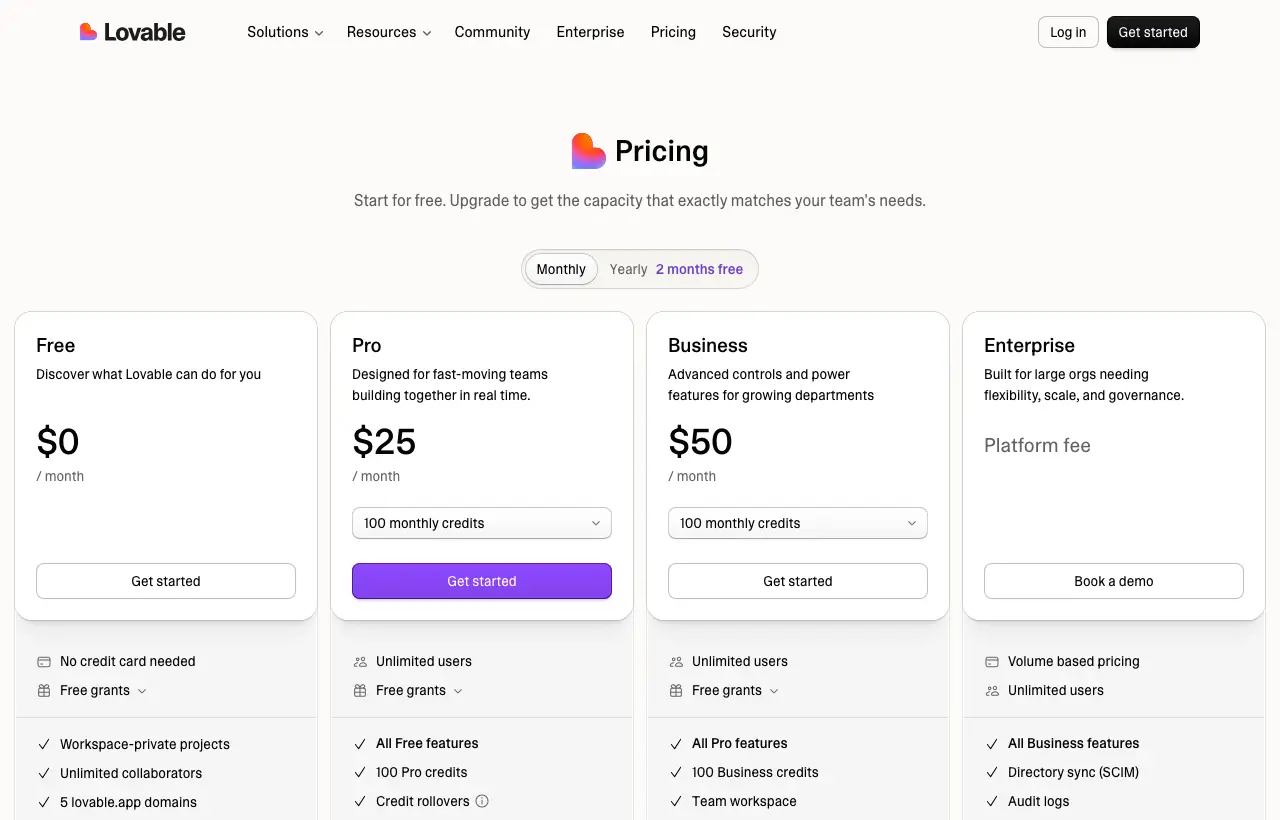
Lovable vs Bolt comes down to who's building. Lovable suits non-coders because it picks the stack for you, while Bolt suits people who can code and want to choose their own stack and database. Both start at $25 a month, but Bolt's 10M monthly tokens roll over, while Lovable's 100 credits expire two months after they're issued and also pay for hosting your live app.
How we compared them. We're a product studio that builds and ships React and Supabase apps for founders, the same stack both tools generate. For this page we read both pricing pages and Lovable's credit documentation, captured both on September 30, 2026, and read the threads where people explain why they picked one over the other. We did not run our own same-prompt test of both tools. Where we cite a head-to-head result, it's one Reddit user's test and we label it that way. The last section covers hiring a team, which is what we sell, so read that part knowing our bias.
Lovable vs Bolt at a glance
Prices rechecked on September 30, 2026.
| Dimension | Lovable | Bolt.new |
|---|---|---|
| Entry paid plan | $25/month, 100 credits | $25/month, 10M tokens |
| Free plan | 5 credits a day (up to 30 a month) | 300K tokens a day, 1M a month |
| Unused allowance | Rolls over, expires 2 months after issue | Rolls over to the next month |
| Teams | Unlimited members, priced by credits | $30 per member per month |
| Hosting | Billed from the same credit balance | Included, with web-request caps per plan |
| Stack control | Stack chosen for you | Choice of stack and database provider |
| Best for | Non-technical founders | Founders or builders who can read code |
Which is cheaper, Bolt or Lovable?
At the entry level, neither: Lovable Pro and
Bolt Pro are both $25 a month. The costs split apart in three places.
Units. Lovable meters credits and Bolt meters tokens, and the two don't convert. Lovable's docs price small changes at under two credits each ("Add authentication" is 1.20). Bolt's token use grows with the size of your project, because each request has more code to read.
Hosting. Lovable pays for building, chat, Cloud hosting and in-app AI from one balance, so a live app with users keeps spending credits after you stop building. Bolt includes hosting on its plans and caps web requests instead (up to 1M on Pro).
Teams. This is where the gap gets large. Lovable prices by credits, not seats, with unlimited members per workspace. Bolt's Teams plan is $30 per member. For a founder plus two collaborators:
- Lovable: one Pro 100 plan = $25 a month for everyone, sharing 100 credits.
- Bolt: Teams at 3 × $30 = $90 a month.
- If the three of you outgrow 100 credits, Lovable's Pro 400 plan is $100 a month, still one bill.
So a solo founder pays about the same on either. A small team usually pays less on Lovable, unless heavy use pushes it up the credit tiers. Lovable notes that its chat pricing is a temporary offering through October 31, 2026, so recheck before you commit to an annual plan.
Lovable: what it gets right and where it falls short
Accessibility. Lovable's biggest strength is also a deliberate limit. It makes the technical choices for you, which means less prompting and fewer decisions a non-coder can get wrong. One user put the tradeoff plainly:
"Lovable won by making the product less flexible. With bolt you could choose which technologies to use, with lovable you don't have that choice. That meant that lovable require a lot less prompting, and was much more accessible to non coders"
r/lovable on Reddit
Output quality. In one user's test of the same prompt plus three edits on both tools, Lovable shipped proper color tokens and heading structure and finished with 1 accessibility issue, against 11 for Bolt. That's a single test, not a benchmark, but it matches the common view that Lovable's output looks more designed.
Where it falls short. Credits get spent fast when a fix takes several attempts, and Lovable's free plan is tight at 5 credits a day. Users also describe it getting shakier as an app grows past MVP size, which we cover in Lovable alternatives.
Bolt.new: what it gets right and where it falls short
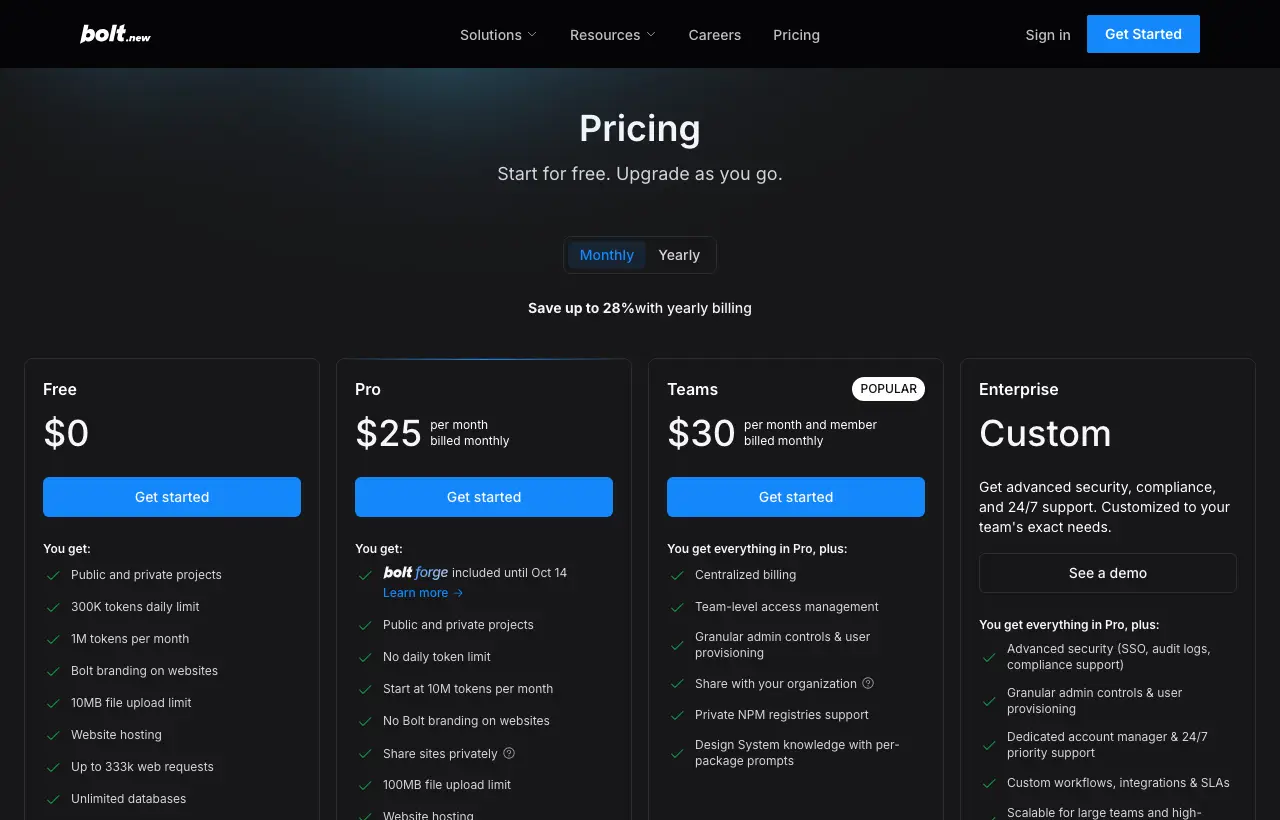
Control. Bolt lets you choose the stack and database provider, and Pro removes Bolt branding and adds a custom domain. If you or a teammate can read code, that flexibility matters more than an easier prompt box.
Speed and allowance. Bolt's free plan is generous for trying things out (1M tokens a month), and on Pro, unused tokens roll over month to month instead of expiring. Users often describe it as the faster option for simple builds:
"Bolt is faster for quick landing pages or simple apps, Lovable can spin up more full-stack stuff but tends to feel shaky once you get past MVP level."
r/vibecoding on Reddit
Where it falls short. Token costs are hard to predict because they grow with the project. Flexibility also means more decisions, which is a real cost for a founder who can't judge them. And per-member team pricing adds up quickly. Where Bolt users go when they outgrow it is in Bolt.new alternatives.
Should you choose Lovable or Bolt?
The shortest summary we found came from a user in the same thread:
"if i summarise bolt for if you know coding and lovable for non coders easy choice"
r/lovable on Reddit
Choose Lovable if:
- you can't read code and want the tool to make technical decisions for you;
- you care about a polished-looking first version for users or investors;
- you're building with collaborators and want one bill instead of per-seat pricing.
Choose Bolt if:
- you or a teammate can read code and want to pick the stack and database;
- you're making quick landing pages or simple apps and want speed;
- you build in bursts and want unused allowance to roll over without expiring.
If you're still deciding between several builders, our vibe coding tools roundup compares Lovable and Bolt with Replit, v0, Base44, Cursor and Claude Code.
When does neither fit, and should you hire a team?
Both tools are built to get a product in front of users fast. Neither is designed to own the parts that make a paying product reliable. One founder described the gap precisely:
"You get the facade, some Supabase plumbing, maybe auth/data if you stay in the happy path, but not the service layer, workflows, queues, webhooks, billing edge cases, auditability"
r/SaaS on Reddit
Switching builders doesn't close that gap. Hiring people who can own the code does. Here's how the three options compare on cost:
- Stay on a builder: $25–$100 a month, plus your own time on every fix.
- A builder plus a coding agent or freelancer: a $20 agent subscription plus whatever the developer's time costs.
- A studio: our Launch Sprint is $6,500 fixed for a designed, built and deployed MVP in 4–5 weeks on average, on Next.js or Flutter with Supabase and Stripe. Ongoing work after launch is $3,500 a month.
A team makes sense when revenue, customer data or an investor deadline depends on the product, and nobody on your side can review code. When an app can't be patched, a rebuild is often faster: for Bounce, an EV rental app with 100,000+ users, we rebuilt the product end to end and signup conversion went from 45% to 65%.
It doesn't make sense before you've validated the idea. If you're still finding out whether anyone wants the product, Lovable or Bolt is the cheaper, faster way to learn that. If you do hire, our guides to questions to ask before signing an agency and rebuilding a no-code MVP cover what to check.