




ask how much it costs to develop an AI agent and you'll hear everything from $5,000 to well past $1 million. both numbers are honest. they're just answering different projects.
the agent market's growing fast enough to explain why: two independent research firms, Precedence Research and
Grand View Research, land within a billion dollars of $11B for 2026. and so is the number of agencies publishing cost guides trying to capture that demand.
figuring out where your actual project lands in that range is the hard part.
the fix: we cross-referenced 3 independent dev-shop guides and they converge on the same shape instead of three different ones. a simple, rule-based agent runs $5,000 to $40,000. a moderate custom agent with real tool access runs $30,000 to $180,000. a full enterprise multi-agent system runs $300,000 to $800,000 or more.
What you'll learn:
- the direct cost answer, cross-referenced across 3 independent dev-shop guides that agree on the shape
- what an agent costs after launch, the ongoing line item most searchers won't think to ask about
- the real dollar premium regulated industries pay for compliance
- how labor location changes the number
- whether a founder can honestly just build one for free instead

three guides, three different client bases, no shared source between them. here's who we cross-referenced and what each one actually found.
Intellectyx,
Codiant, and
Ditstek each publish their own AI agent cost guide, aimed at different clients, updated on their own schedule. none of them cite each other.
3 independent guides, same shape
| Intellectyx | Codiant | Ditstek | |
|---|---|---|---|
| Simple / entry tier | $15K–$40K | $5K–$20K | not broken out |
| Moderate / custom tier | $40K–$180K | $20K–$100K | $30K–$80K |
| Enterprise tier | $300K–$800K+ | $100K–$500K+ | $100K+ |
dreamlaunch
Sourced from Intellectyx, Codiant, and Ditstek, all 2026. Three agencies that don't cite each other, landing on the same entry point and the same enterprise ceiling.
that's genuine cross-source agreement, not a single vendor's number repeated.
Codiant's own FAQ puts it almost identically to the direct answer above: "a simple AI agent could cost between $5,000-$20,000, while a highly customized, learning-based agent might range anywhere from $100,000 to $500,000+."
Ditstek's guide lands in the same neighborhood from the middle: "a moderately capable AI agent typically requires an initial investment of USD 30,000 to 80,000," with enterprise-grade agents starting from $100,000.
the entry point clusters around $5,000 to $40,000. the enterprise ceiling clusters around $300,000 to $800,000. three different agencies, three different client bases, the same real range.
what the 5 complexity tiers actually cost
Intellectyx's own breakdown is the most granular of the three, five tiers instead of three:
- rule-based agent: $15K–$40K, 4–8 weeks, example: FAQ chatbot, ticket router
- single-task AI agent: $40K–$100K, 8–14 weeks, example: lead qualifier, document summarizer
- multi-tool AI agent: $80K–$180K, 12–20 weeks, example: research agent, CRM automation
- multi-agent system: $150K–$350K, 16–28 weeks, example: autonomous sales pipeline, HR onboarding
- enterprise agentic AI: $300K–$800K+, 24–40+ weeks, example: full workflow automation, agentic ERP layer
a rule-based agent matches inputs to a fixed set of scripted responses, it doesn't reason. a real AI agent plans, decides what tool to reach for, and adjusts when the first approach doesn't work. that difference in judgment is most of the jump from $15K-$40K to $80K-$180K.
for a real, full-length look at what actually goes into building one of these across all five tiers: freeCodeCamp's complete Agentic AI course for beginners walks through the real engineering work behind these numbers, from a rule-based bot up through multi-agent orchestration.
the ongoing cost nobody asks about?
the build isn't the last bill. two independent sources quantify a real, distinct operating cost that kicks in after launch and keeps running for as long as the agent does:
- LLM API costs (scales with usage): $12K–$120K+/yr
- vector database hosting (Pinecone, Weaviate, ChromaDB): $2K–$20K/yr
- cloud infrastructure (GPU instances, storage, load balancing): $10K–$80K/yr
- model monitoring: $5K–$30K/yr
- security and compliance: $15K–$60K/yr
- quarterly model updates: $8K–$40K/yr
Intellectyx's own key insight: for a mid-complexity enterprise agent handling 50,000 interactions a month, expect $40,000 to $120,000 a year in operational cost beyond the initial build.
Ditstek independently lands in an overlapping range from the other direction: $3,000 to $10,000 a month in infrastructure, annualizing to roughly $36,000 to $120,000, plus $10,000 to $30,000 a year in model updates on top of that. two agencies quoting from different angles, landing in the same real range.
that 50,000-interactions figure is enterprise scale, not a pre-seed founder's real usage. the line items themselves are still real at any scale, they just get cheaper as volume drops.
an agent handling a few hundred conversations a month runs a real API bill, just a small fraction of the enterprise number above, not zero. the mistake isn't misreading the enterprise figure, it's assuming these categories don't apply at all until the enterprise stage.
this is also the part of the quote most likely to get glossed over in a first conversation with a vendor, since it's smaller and less dramatic than the headline build number. worth asking directly which of the six line items above are already estimated in a given proposal, and which ones are being left for later.
the compliance premium is real and priced
regulated industries pay a quantified premium on top of the base build. SOC 2 Type II certification adds 3 to 4 months and $30,000 to $60,000 to a project timeline and budget.
HIPAA-compliant agents add their own real requirements on top: PHI data isolation, audit logging, encryption at rest and in transit, and Business Associate Agreements with every vendor touching the data.
an enterprise compliance premium prices for a system that has to satisfy an outside auditor. a pre-seed founder's first agent usually has one real stakeholder to satisfy: does it actually work. that's not a loophole, it's a genuinely different, smaller scope, and the honest reason a founder's real number sits well below the compliance-heavy figures most guides lead with.
labor rate changes the number too
Intellectyx's own regional breakdown shows why two agencies quoting the same scope can land far apart on price before either has done an hour of work.
Hourly rate by team location
| US-based senior AI engineers |
$150–$250/hr
|
| Nearshore (LatAm, Eastern Europe) |
$60–$100/hr
|
| Offshore (India, Southeast Asia) |
$30–$70/hr
|
dreamlaunch
Source: Intellectyx, 2026. Bars scaled against the US rate, the top of this specific range.
the same source recommends vetting any offshore team with a paid proof-of-concept before committing to a full engagement, worth taking seriously: quality varies a lot more at the lower end of that range than the rate card alone reveals.
a lower rate can mean a genuinely capable team at a lower cost of living, or it can mean a less senior team taking longer to reach the same result. the hourly number alone doesn't say which.
rate isn't the whole story either. a US-based team billing $150-$250/hr on a tightly-scoped 6-week build can land at a lower total cost than an offshore team billing $30-$70/hr across a poorly-scoped 6-month one. the hourly rate multiplies against hours actually spent, and a team that scopes the problem correctly the first time spends fewer of them.
we go deeper on what separates a team worth that rate from one that isn't in how to hire (or vet) an AI agent developer for your startup.
cost by industry, one source's real breakdown
Intellectyx also breaks its numbers down by industry vertical, worth noting as one vendor's view rather than a triangulated fact, since it wasn't independently cross-referenced against the other two guides:
- financial services: $120K–$500K+, driven by regulatory compliance and audit trails
- healthcare: $100K–$400K, driven by HIPAA compliance and EHR integration
- manufacturing: $80K–$300K, driven by IoT sensor integration and OT system connectivity
- professional services: $60K–$250K, driven by knowledge retrieval and multi-source integration
- retail and e-commerce: $50K–$200K, driven by real-time personalization and catalog integration
the pattern across all five: regulated, audit-heavy industries sit at the top, and industries where the agent's mistakes are cheaper to correct sit at the bottom. that tracks with the compliance premium above, it's the same driver showing up industry by industry instead of certification by certification.
it's also a useful sanity check against a quote that seems out of line with everything else in this article: a fintech agent handling trading decisions or fraud detection genuinely does carry more regulatory weight, real-time data requirements, and auditability demands than a retail product-recommendation agent. a quote that reflects that isn't automatically overpriced. the vertical matters as much as the complexity tier.
can a founder honestly just build one for free?
the real search behavior behind this exact query skews toward exactly that question: are AI agents free to build, can I build my own AI agent. it's a fair question, and it deserves an honest answer instead of a dismissal.
yes, for a genuinely narrow scope. a single-purpose automation wired together with a no-code tool or a free framework can work, and works honestly well for a task with a fixed, predictable shape: summarize this document, route this ticket to the right queue, draft a first-pass reply for a human to edit.
what free tools don't get a founder to is the $40K-$180K tier this article is mostly about: an agent that reasons across multiple tools, recovers when a step fails instead of just stopping, and keeps working correctly as the product it's wired into actually changes underneath it. that's a fundamentally different engineering problem than wiring a prompt to an API call, even though both get called "AI agents" in a sales conversation.
that's the real dividing line, not effort or budget: does the job need judgment, or does it need a fixed script executed reliably. ChatGPT and no-code builders are genuinely good at producing code and simple automations quickly. they don't replace the judgment of a team that scoped the actual problem, chose what the agent should and shouldn't be trusted to decide on its own, and built in a way to catch it when it's wrong, before a customer sees the mistake instead of after.
what a real 6-week build looks like, priced honestly
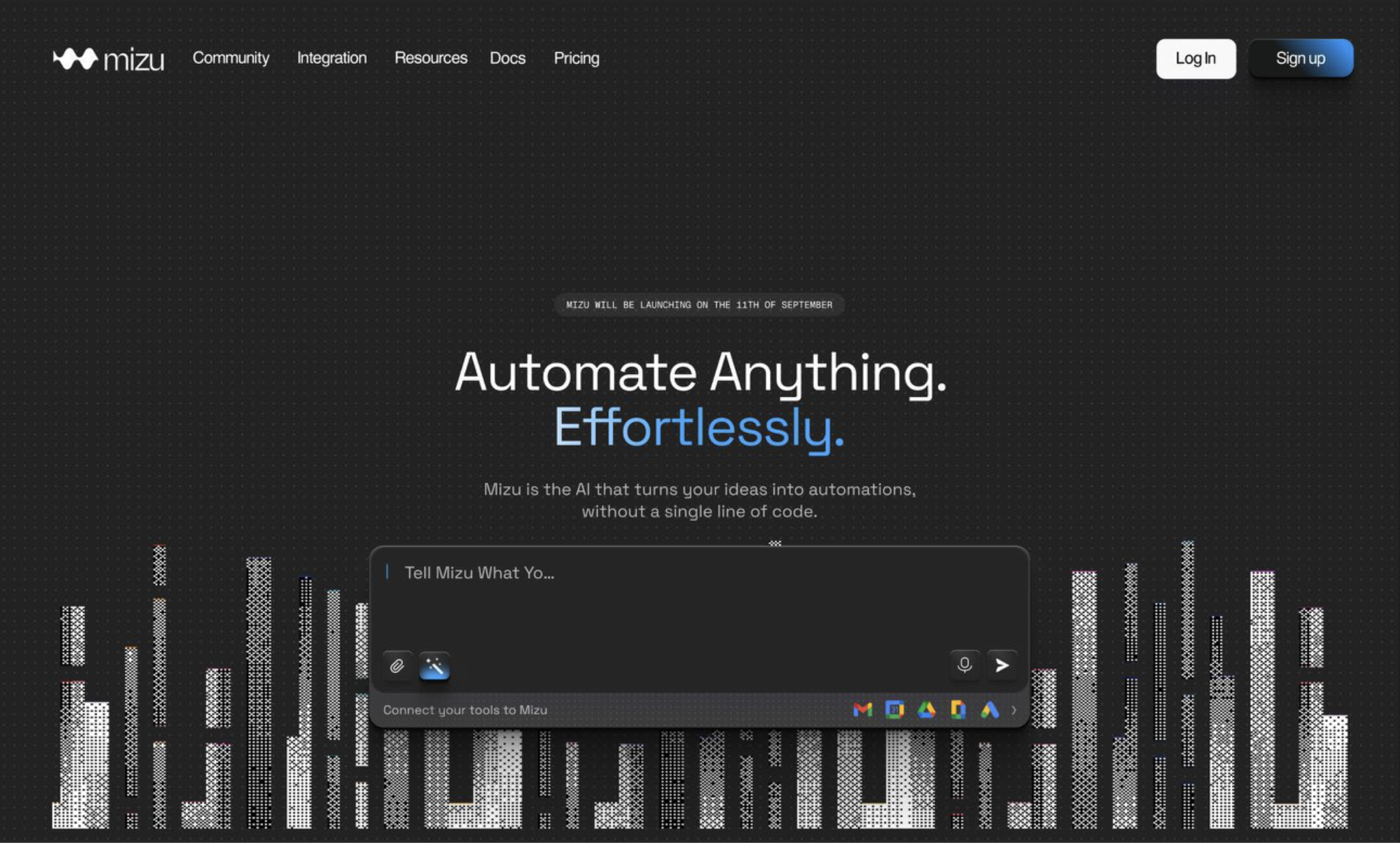
a real example that sits between "free DIY tool" and a $150,000+ enterprise engagement: Mizu AI, an AI-native automation builder DreamLaunch took from a blank page to a live product in six weeks with Andrej, a solo founder.
the agent itself: describe a workflow in plain English, it asks what it needs to know, then plans and builds the automation, with a visual canvas underneath so it's never a black box. five real integrations at launch, Gmail, Slack, Calendar, Notion, and Docs, plus billing and onboarding, all owned outright, not licensed per seat or metered per API call on top of an agency's hourly rate.
it wasn't free, a real technical partner did the work. it also wasn't a $300,000 enterprise multi-agent engagement, because it didn't need to be one: a single founder's actual scope, built to that scope, in six weeks. that's the honest middle a lot of cost guides skip past entirely, jumping straight from "free" to "enterprise" with nothing real in between.
if the next step is finding who actually builds these, not just what they cost: we hand-picked and vetted 9 real AI agent development companies against live client reviews, not just whoever added the label to their homepage.
the fixed-scope, six-week shape matters as much as the dollar figure. an enterprise agentic AI engagement runs 24 to 40+ weeks per the tier breakdown above, plenty of time for the original spec to drift from what the business actually needs by the time it ships. a tightly-scoped build finishes fast enough that the thing being built and the thing the business actually needs at launch are still the same thing.