




a $80,000 quote to build your AI agent sounds like a complete number. it usually isn't. it's the number for the agent itself, and the infrastructure, orchestration, and observability layer underneath it often adds another $30,000-$50,000 that shows up after the contract is signed, not before.
demand for custom AI agents is real and expanding fast enough that the gap between the headline quote and the actual total cost has become a common, predictable pattern rather than an occasional surprise. agencies aren't hiding this on purpose, most of the time. the quote genuinely is for the agent, the infrastructure conversation just happens later, once you're already committed.
knowing which number applies to you, the headline quote or the real total, is the part every generic pricing table skips.
the fix: a focused single-workflow agent runs $15,000-$40,000, a RAG-powered agent with real integrations runs $40,000-$100,000, and a multi-agent system with compliance requirements runs $150,000-$500,000+, according to a direct cost breakdown independently cross-checked against a broader industry aggregate. the number that actually matters is the second one: what the infrastructure and ongoing operating cost adds on top, before you sign anything.
What you'll learn:
- Real AI agent development cost bands by tier, cross-referenced from independent sources
- The hidden infrastructure cost most quotes leave out, and why it shows up later
- Whether you can actually build your own AI agent, and when that's the right call
- What ongoing operating costs look like after the agent ships
- A real example of a founder who went from nothing to a live agent-based product in 6 weeks
what a "custom ai agent" actually is
an AI agent is different from a chatbot in one important way: a chatbot mostly answers questions, an agent takes actions. it can query systems, call tools, make decisions across multiple steps, and often operate with some autonomy rather than waiting for a single prompt-response turn. that's a meaningfully bigger engineering job than a conversational interface, which is why agent development costs run higher than chatbot development at every comparable tier, even when both use a similar underlying model. if what you actually need is something that answers questions well rather than takes multi-step actions, Chatbot Development Services: Real Cost Bands for 2026 is the more accurate piece to be pricing against.
the "takes actions" part is also where most of the real engineering risk lives, and where the hidden costs later in this piece actually come from. a chatbot that gives a wrong answer is embarrassing. an agent that takes the wrong action, books the wrong appointment, sends the wrong refund amount, updates the wrong record, causes a real operational problem, not just a bad conversation. that's why agent builds need an orchestration and observability layer a chatbot doesn't: something has to catch a bad decision before it executes, log what happened when it doesn't, and give a human a way to intervene. that layer is real engineering work, and it's exactly the part a bare "build me an agent" quote tends to leave out.
real cost bands for custom ai agent development
the most granular breakdown available, cross-checked against a second, independently-published source, lands on four real tiers:
- Focused MVP / single workflow: $15,000-$40,000, typically open-source models handling one workflow, e.g. a customer FAQ agent
- RAG-powered agent with integrations: $40,000-$100,000, connecting to 2-3 real systems, e.g. support deflection use cases
- Multi-tool autonomous agent: $80,000-$200,000, with a governance layer, e.g. finance operations use cases
- Multi-agent, compliance-heavy system: $150,000-$500,000+, involving custom model considerations
dreamlaunch
Cost bands from Decipherzone's 2026 breakdown, cross-checked against a broader industry aggregate, current as of publish.
industry matters too: healthcare and financial-services agents commonly run $120,000-$400,000+ because of compliance and auditability requirements, while HR and customer-support agents sit lower, typically $40,000-$150,000. treat the industry-specific figures as directionally reliable rather than a hard quote, they weren't independently re-verified against a second source with the same rigor as the tier breakdown above.
a second, independently-published source lands on the same order of magnitude from the other direction: Azilen puts the full range at $10,000 for a basic FAQ-style agent to $400,000+ for a full multi-agent orchestration system, with ongoing costs of $3,200-$13,000 a month for a production agent serving real users. two sources compiled independently, arriving at the same rough shape from different methodologies, is the closest thing to a verified number this category has before you have your own spec in hand.
the hidden cost every headline quote leaves out
a quote is a snapshot, not a total. the running cost of the system it describes is a different number entirely, and it's the one that actually determines whether the project stays in budget.
Decipherzone puts this plainly: headline quotes like "$80,000 to build your AI agent" rarely model the $30,000-$50,000 in infrastructure, orchestration, and observability tooling that a production-grade agent actually needs to run reliably. that's not a hidden fee, it's a real, separate category of cost that most quotes simply don't include because the quote is scoped to "build the agent," not "run the agent in production."
on top of the build cost, ongoing operating costs commonly run $5,000-$15,000 a month in API costs for production deployments, depending on conversation volume and complexity, with production multi-agent systems specifically running $300-$3,000 a month just for the orchestration layer. infrastructure, ongoing LLM usage, integration complexity, maintenance, and governance combined typically add 40-80% to the first-year total cost of ownership beyond the initial build number. ask for that first-year total upfront, not just the build quote, before comparing two vendors against each other.
A $70,000 RAG-agent quote, worked through
The quote vs. the real first-year total
| Headline quote |
$70,000
|
| + Infrastructure & observability |
+ $40,000
|
| Real first-year total |
~$130,000
|
dreamlaunch
Illustrative worked example at the RAG-agent tier, built from Decipherzone's cited hidden-cost range and first-year TCO uplift.
can you actually build your own ai agent?
this is a real, frequently asked question, not a hypothetical: can I develop my own AI agent? the honest answer is yes, for a genuinely simple, single-workflow case, using off-the-shelf tools and an existing LLM API. plenty of founders have shipped a working first version this way, and it's often the right move for pure concept validation.
where it stops working is the same place every DIY AI build stops working: the moment the agent needs to handle real user data reliably, integrate with more than one or two systems, or keep working when the underlying model provider changes its API or rate limits. a demo that works for you, testing it yourself, and a production system that works for thousands of real users hitting edge cases you didn't think to test, are different engineering problems wearing the same UI.
there's a specific failure pattern worth naming, because it's common enough to plan around: a founder builds a working agent prototype in a weekend using a no-code tool or a quick script against an LLM API, shows it to a handful of friendly early users, and it works. then it goes live to a real audience, and the exact scenarios it wasn't tested against start showing up: a user phrases a request in a way the agent misreads, an integration times out under real load, an edge case in the data triggers a bad decision nobody caught in testing. none of that means the DIY version was a waste, it proved the concept and the demand, which is genuinely valuable. it means the gap between "works in a demo" and "works in production" is real engineering, not a formality, and it's exactly the gap a $15,000-$40,000 focused build closes.
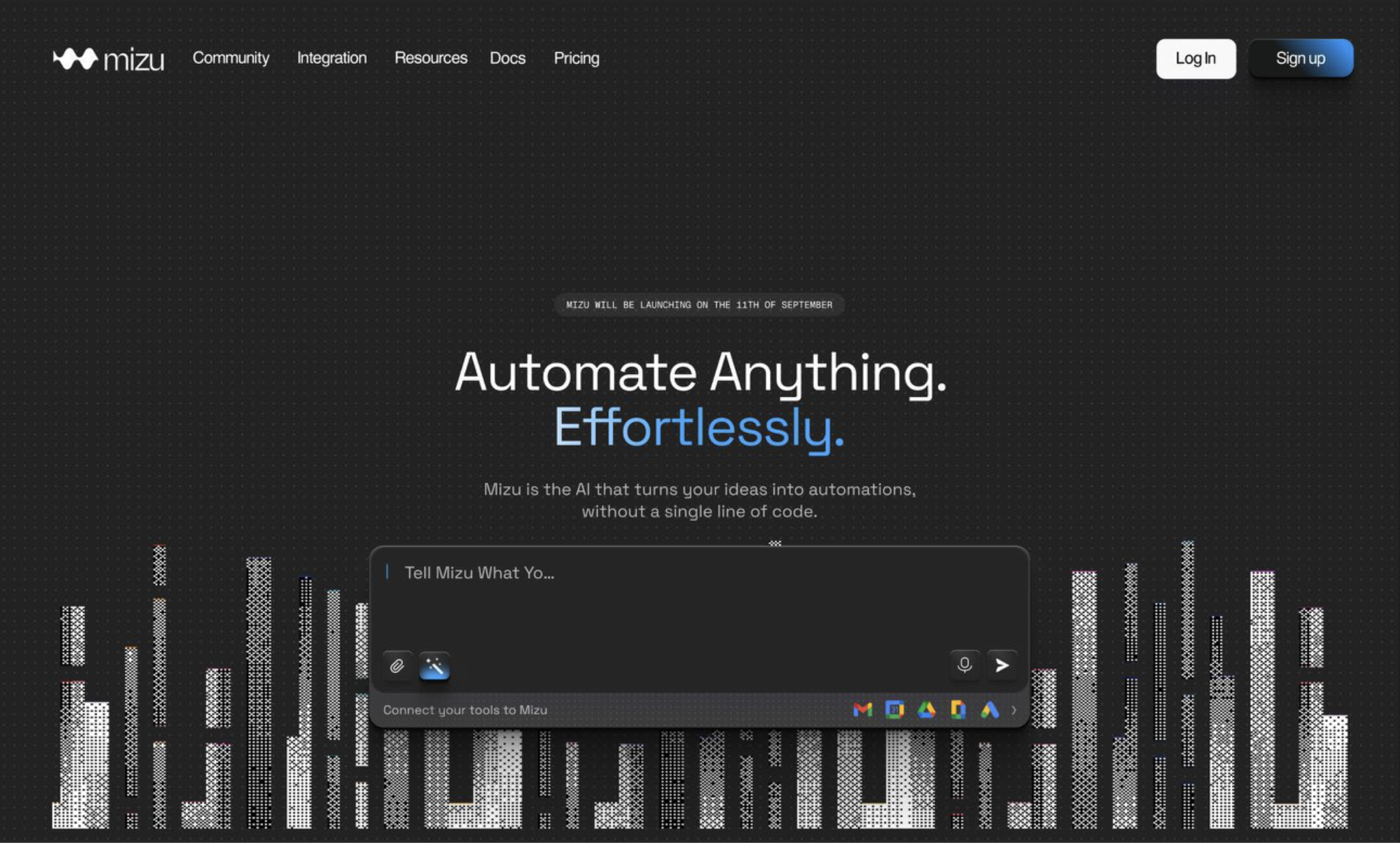
Mizu AI sits right at that line. the founder started with an idea and nothing else, no product, no frontend, no backend, no team, wanting an AI automation builder that anyone could use just by describing what they needed in plain English, in a category already crowded with funded competitors. six weeks later it was a live, full-stack product, not a working demo. the difference between that outcome and a DIY prototype that stalls at "it works when I test it" is exactly the infrastructure and integration work the hidden-cost section above describes, done upfront instead of discovered later.
questions to ask before signing an ai agent quote
the hidden-cost gap above is avoidable, not inevitable, if you ask the right questions before signing rather than after the first invoice with a surprise line item on it:
- Is the infrastructure and observability layer included in this number, or separate? if separate, get that number too, before comparing this quote to a competing one that might already include it.
- What's the expected monthly operating cost once this is live? a vendor who's actually run agents in production has a real number here. one who's only built demos gives a vague answer.
- What happens if the underlying model provider changes pricing or rate limits? this has happened repeatedly across every major LLM provider. a team that's dealt with it has a plan. one that hasn't is passing that risk to you, silently.
- What's the realistic first-year total, not just the build cost? given the 40-80% typical uplift from infrastructure, LLM usage, and maintenance, this is the number that actually determines whether the project fits your budget.
if you're earlier in the decision, still figuring out whether you need an agent built or need advisory help scoping the problem first, What Generative AI Consulting Services Actually Cost covers that fork directly. and if the core technical question is connecting an existing LLM into your stack rather than building an autonomous agent, LLM Integration Services: What They Actually Cover in 2026 is the more accurate piece.
for a genuinely thorough walkthrough of building agents end to end, Simplilearn's full course covers the practical steps most quotes are actually pricing: