




Clutch's AI Consulting directory lists 9,645 companies. Only 30 of them carry a "Leader" or "Contender" badge, Clutch's own vetted tiers built from verified client reviews.
this list is 9 of those, all headquartered in the US, pulled live from Clutch today: real ratings, real review counts, real pricing bands. worth knowing going in: the market itself is moving fast enough that picking the wrong partner is an expensive mistake to make twice, Grand View Research puts the global AI market at $539.5 billion in 2026, up from $390.9 billion in 2025, on its way to a projected $3.5 trillion by 2033. a lot of companies are rushing to call themselves "AI consultants" while that curve is still steep.
What you'll learn:
- 9 real US AI automation consulting companies, with their actual Clutch rating, review count, and pricing band
- the honest difference between an AI-first specialist and a generalist software shop that added "AI consulting" as a service line
- what a consultancy actually delivers versus what a build actually requires
- a real example of a company that skipped the advice stage and went straight to a working product
- what to actually check before signing with any of them
9 real AI automation consulting companies (Clutch data, live)
1. Intuz — San Ramon, CA
4.8★ (53 reviews) · $10,000+ minimum · $50–$99/hr · 50–249 people · $10,000–$49,000 avg. project cost.
50% AI development, 40% AI consulting, a real specialist split rather than AI as a side offering. Their Clutch profile cites a 95% reduction in fraudulent postings for one client and a 90% time savings in documentation work for another, concrete outcomes rather than generic praise.
Fits a founder who wants a partner that can point to a measurable result, not just a strategy deck.
2. Sketch Development — Webster Groves, MO
5.0★ (23 reviews) · $10,000+ minimum · $150–$199/hr · 10–49 people · under $10,000 avg. project cost.
A smaller, AI-implementation-focused shop. Their profile cites shipping an AI-powered resume platform, Jobsprk, in under six weeks, with 100% positive reviews highlighting communication and strategic foresight.
Worth a look for a small, well-scoped AI feature that needs to move fast.
3. Liquid Technologies — Houston, TX
4.9★ (18 reviews) · $10,000+ minimum · $25–$49/hr · 50–249 people.
The lowest hourly rate on this list, with AI work (consulting, development, agents, generative AI combined) making up about 60% of their business, the rest custom software and web. Their profile shows roughly 90% of reviewers citing responsive communication and timely delivery.
4. EffectiveSoft — San Diego, CA
4.9★ (19 reviews) · $25,000+ minimum · $50–$99/hr · 250–999 people.
A larger team where AI (consulting, agents, generative AI) makes up around 40% of the business, alongside custom software and cloud consulting. Their profile shows about 90% of reviewers citing flexibility and professionalism, with over 70% specifically noting adaptability to unusual requirements.
5. Queryon — Anchorage, AK
5.0★ (9 reviews) · $10,000+ minimum · $100–$149/hr · 50–249 people.
A data-and-BI-leaning consultancy, 20% AI consulting, 20% AI development, 20% BI and big data. Their profile shows 100% of reviewers citing strong communication and project management.
Fits a business whose "AI problem" is really a data-quality problem first.
6. Achievion Solutions — McLean, VA
4.8★ (17 reviews) · $25,000+ minimum · $50–$99/hr · 10–49 people.
An AI-first boutique: 30% AI development, 10% AI consulting, 10% AI agents. Their profile shows 100% positive feedback on structured communication and responsiveness, with one honest counterpoint: reviewers note they'd like more proactive design guidance, not just execution.
7. BlueLabel — New York, NY
4.7★ (70 reviews) · $75,000+ minimum · $100–$149/hr · 50–249 people · $10,000–$49,000 avg. project cost.
25% AI consulting, 25% generative AI, 20% AI development, a genuinely AI-centered practice rather than a generalist shop. Their profile shows 100% of clients citing strategic clarity and on-time, on-budget delivery.
8. SF AI Labs — San Francisco, CA
5.0★ (19 reviews) · $10,000+ minimum · $100–$149/hr · 10–49 people.
The most AI-concentrated business mix on this list: 40% AI consulting, 35% AI development, 20% AI agents, 95% of their work is some form of AI. Their profile shows 100% positive feedback, reviewers specifically citing deep expertise and strategic recommendations tied to real business needs.
9. MojoTech — Providence, RI
5.0★ (13 reviews) · $100,000+ minimum · $150–$199/hr · 50–249 people.
The highest minimum budget and the most generalist scope on this list, AI consulting is only 15% of their business, the rest custom software, UX/UI, and web development. Their profile shows 100% of clients praising project management and the ability to turn complex requirements into scalable products.
a Clutch rating tells you a company did real, verified work for real clients. it doesn't tell you whether AI is what they actually specialize in. three of the nine above (Liquid Technologies, EffectiveSoft, MojoTech) are general software shops where AI consulting is a minority service line, not the main business, worth knowing before assuming uniform depth of AI expertise across this entire list.
advisor or builder: the distinction that actually matters
"AI automation consulting" gets sold as one category, but it splits into two genuinely different engagements. an advisory engagement produces a strategy, an audit, a roadmap, a recommendation for what to build and how. a build engagement produces the thing itself, live, running, maintained.
both are legitimate. the mismatch happens when a business needs the second one and buys the first. a strategy deck doesn't automate anything by itself, someone still has to build what it recommends, and that's a second engagement, often with a second vendor, often months later. Gartner found that at least 50% of generative AI projects were abandoned after the proof-of-concept stage, citing poor data quality, escalating costs, and unclear business value as the leading causes, exactly the gap that opens up when the advisory phase and the build phase are two separate, disconnected engagements.
Gartner, 2026
What happens to a generative AI project after the strategy phase
dreamlaunch
Source: Gartner, "Why 50% of GenAI Projects Fail, and How to Beat the Odds," 2026.
Two different engagements
| Advisory consulting | A built automation | |
|---|---|---|
| What you get | A strategy document, roadmap, or audit | A live, working product |
| Who builds it after | Usually a separate team, a separate contract | Already built, by the team that scoped it |
| Time to something running | Weeks for the strategy, then a second timeline to build | One timeline, ends with a live product |
dreamlaunch
Not a claim that advisory work is worthless, some businesses genuinely need the strategy piece first. Know which one you're buying before you sign.
what it looks like to skip straight to a working product
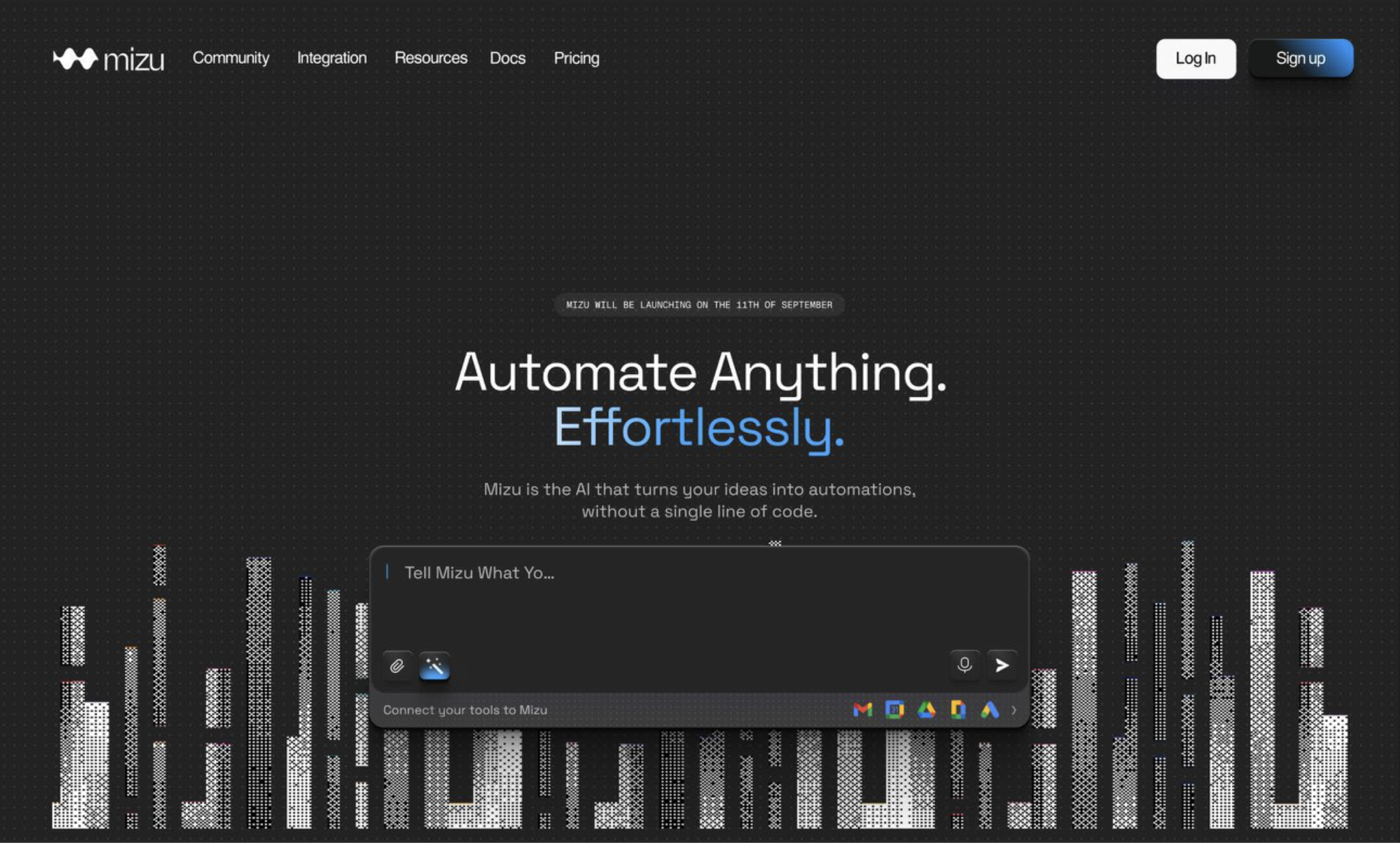
a real example of the build path: Mizu AI, an AI-native automation builder DreamLaunch took from a blank page to a live product in six weeks, no separate strategy phase, no handoff to a different team. describe a workflow in plain English, the AI asks what it needs to know, then builds it, with a visual canvas underneath so it's never a black box. five real integrations shipped at launch, Gmail, Slack, Calendar, Notion, and Docs, plus billing and onboarding.
the founder didn't need someone to tell him AI automation was a good idea, he needed the thing built. that's the honest test for whether an advisory engagement or a build is the right call: if the answer to "should we do this" is already yes, the question that's actually left is who builds it, and how fast.
if that's where a business is, that's the kind of build DreamLaunch does, scoped once, built for the actual workflow, maintained after launch.
what to actually check before signing with any of them
a rating and a review count confirm a company has done real work for real clients. they don't confirm which of the two engagements above you're about to buy, or whether that's the one your business actually needs.
ask directly: does this engagement end with a strategy document or a working product? if it's a strategy document, ask who builds the recommendation afterward, and whether that's included or a separate contract, that handoff point is exactly where Gartner's 50%-plus abandonment rate tends to happen. ask for the scope fixed in writing either way, not an open-ended hourly estimate. ask what percentage of their business is actually AI-focused versus a service line added onto a broader software practice, several names on the list above answered that question very differently. ask what data the automation actually needs to work reliably, and whether that data already exists in usable shape, "poor data quality" was Gartner's single most-cited reason projects stall. a company that answers all five clearly before you've signed anything is showing you how it'll behave once you have.