



A founder i spoke to last year had spent eight months looking for a technical co-founder. Attended every startup event in his city. Posted on every forum. Had 40+ coffee chats. Came close twice. Both times the person disappeared after equity conversations got real.
His idea wasn't bad. It was actually good. He just spent eight months not building it.
i'm not writing this to tell you that finding a technical co-founder is the wrong move. sometimes it's the right one. i'm writing this because there's a whole category of non-technical founders who are stuck at the idea stage not because they lack clarity — but because they've been told, implicitly, that they can't move without a technical partner sitting across the table from them.
that's not true anymore. here's what actually works.
the validation you skip at your own expense
before any line of code, before any hire, before you write a single job description — there's one thing that determines whether you'll waste $20,000 or ship something real.
you need to know if people will pay for the manual version of what you want to automate.
i know that sounds obvious. it almost never is. the founders who skip this step are usually the ones who come to us six months later with a built product and zero users. the ones who do it properly — who spend two to three weeks manually doing the thing they want AI to do, using spreadsheets and google docs and their own time — those founders arrive at build day knowing exactly what the product needs to do and who it needs to do it for.
so before you hire anyone or touch an MVP development partner, answer this: can you deliver the outcome of your product manually, even once, for one paying customer?
if yes, you have a real problem worth solving. now you can think about building.
what you actually need to understand about AI (it's less than you think)
i was wrong about this for a long time. i thought non-technical founders needed to learn enough to build. they don't.
what you need to understand is enough to make decisions and catch bad advice.
here's the short version: almost every AI product being built for startups right now is not using a custom-trained model. it's using a foundation model — GPT-4o, Claude, Gemini — accessed through an API, combined with your data, your prompts, and your product logic. the "AI" in most startup AI products is a well-designed integration, not a research breakthrough.
that matters because it reframes your job. you're not trying to understand machine learning theory. you're trying to understand what input goes in, what output comes out, and what the user experience looks like in between. that's product thinking. you already have it.
the technical side — the API calls, the vector databases, the prompt engineering, the infrastructure — that's the engineering layer. it can be hired.
the three options most founders actually have
option 1: no-code and AI tools
tools like Bubble, Cursor, Lovable, and v0 have genuinely lowered the floor. if your product is relatively simple — a single workflow, a clean interface, one or two AI features — you can get surprisingly far with these tools and enough patience.
the ceiling is real though. when you need custom integrations, complex data handling, production-grade security, or anything that scales beyond a few hundred users, these tools start showing their limits. a prototype built on a no-code platform is not the same thing as a production-ready product. that gap has cost founders i know upwards of $40,000 in rebuilds.
use these tools to validate. don't use them to launch something you intend to scale.
option 2: a freelance developer
this works, sometimes, with the right person. the problem is that a single developer — even a good one — rarely has the full stack of skills an AI product needs: product thinking, AI architecture, backend infrastructure, and frontend that users actually want to use.
you'll get the code. you won't necessarily get the product.
if you go this route, hire someone senior enough to push back on your assumptions. the developers who only build what you describe are the expensive ones in the long run.
option 3: a specialist build partner
this is where it gets practical for most founders i talk to. an AI-focused product studio — one that has built these integrations before, knows the architectural decisions, and ships to production — compresses six months of trial and error into four to six weeks.
the cost is real. starting at $6,500, it's not a trivial investment. but compared to eight months of co-founder searching, two failed freelancer engagements, and a no-code rebuild, the math usually lands differently than founders expect.
when we built Mosaic — an AI app — from concept to App Store in 7 weeks, the founder wasn't technical. what she had was clarity about the problem and trust in the build process. that combination ships products. a CS degree doesn't.
the conversation you need to have before you hire anyone
i see non-technical founders make the same mistake when they finally decide to hire: they hand over a vague idea and wait for someone else to turn it into a spec.
don't do that.
before you talk to any developer, studio, or freelancer, be able to answer these four questions clearly:
what's the one-sentence workflow? "the product takes [this input], processes it with AI to produce [this output], and delivers it to [this type of user]." if you can't fill that in, the idea needs more thinking, not more building.
who are the first 10 users? not the target market. actual names, or at least an actual community you have access to. products built for "everyone" ship for no one.
what does version one not include? the feature list will always be longer than the first version should be. know what you're cutting before you start. every feature you add in week one is two features you'll need to maintain in week six.
what does success look like at 90 days? a number. not "traction" or "growth." active users, paying customers, conversion rate — pick one metric that tells you whether the product is working.
the builder you hire with this level of clarity will produce a completely different outcome than the one you hire without it.
the technical decisions that aren't yours to make — but are yours to ask about
i'm not going to tell you to learn to code. i don't think that's the best use of your time at this stage. but there are four questions worth asking any developer or studio you're considering working with:
which AI model are you planning to use and why? if the answer is "ChatGPT" without any further explanation, that's a flag. the choice of model matters and should be justified against your use case.
how are you handling user data? AI products process sensitive inputs. you need to know where data goes, whether it's used to train third-party models, and what the compliance posture looks like.
what's the estimated API cost per active user per month? AI products have variable infrastructure costs. a product that's fine at 100 users can become unprofitable at 10,000 if nobody modelled the unit economics. ask early.
what does the handoff look like? when the build is done, do you own the codebase? is it deployed to your own infrastructure? can another developer pick it up? these questions separate partners who are building for you from ones who are building dependency.
you don't need to understand every answer technically. you need to notice whether the person you're talking to can give a clear, honest answer or deflects into jargon. that tells you more than the technical content does.
what the actual build process looks like for a non-technical founder
here's what the four to six weeks look like when it works properly.
week one is almost entirely conversations and decisions. what's the product, who's it for, what does the AI actually do, what does the interface feel like. your job in this phase is to be opinionated and responsive. the worst client in any build is the one who's unavailable.
weeks two and three are the core build. you're reviewing working features, not mockups. you're giving feedback on real screens with real AI output. you're noticing when something feels off and saying so immediately — not waiting until the final review.
weeks four through six are testing, edge cases, and launch prep. this is where the product gets to production-ready. it's not glamorous work. it's important work. non-technical founders who stay engaged here catch problems that would take weeks to fix post-launch.
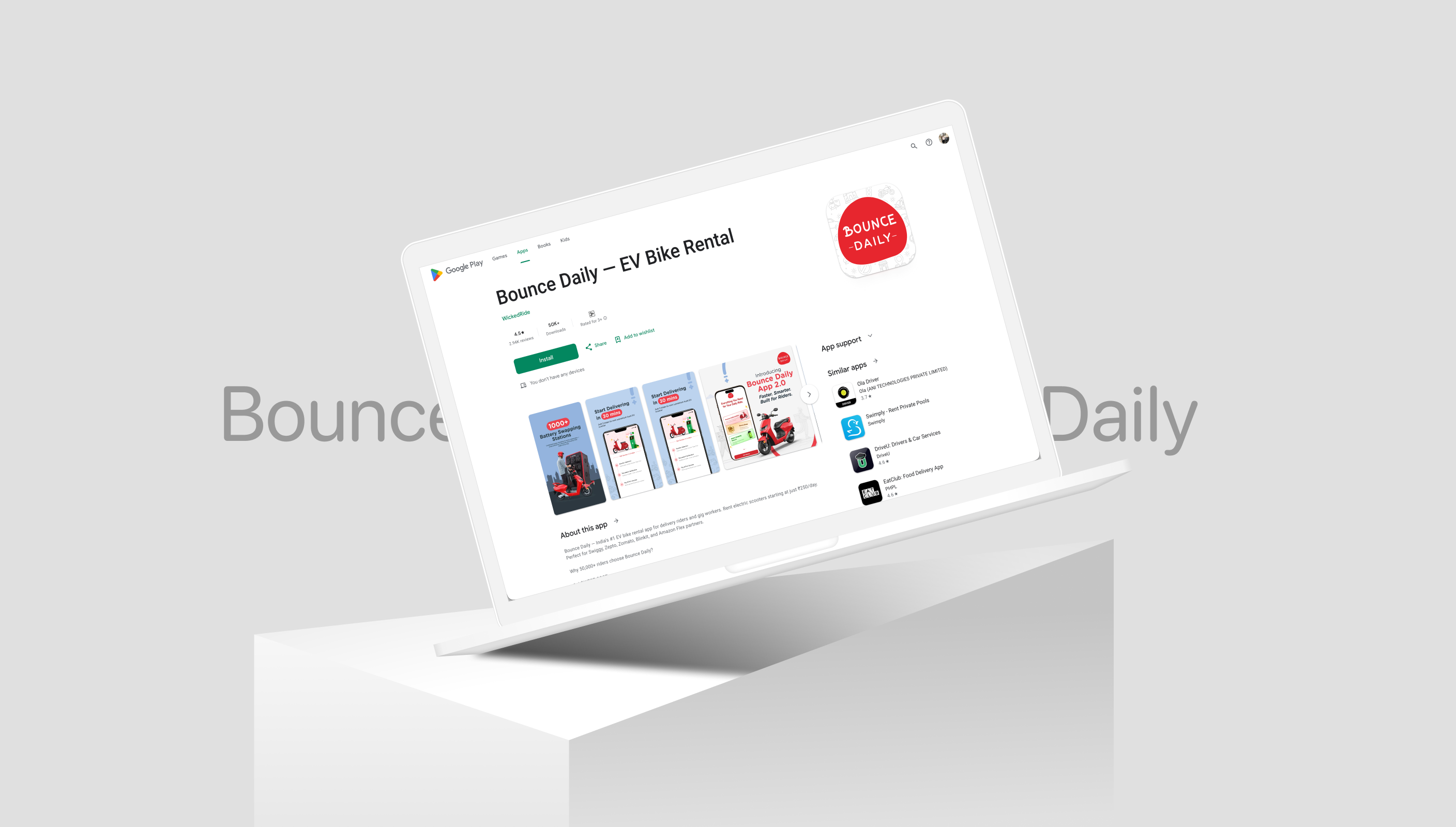
when we rebuilt Bounce Daily — a 100,000-user EV rental app — the thing that moved KYC conversion from 45% to 65% wasn't a clever AI feature. it was a founder who was in the details, who knew what a frustrated user looked like, and who gave feedback fast. the technical execution matters. so does your involvement.
the thing nobody tells you about not having a technical co-founder
i thought the absence of a technical co-founder was a gap to fill. it's actually a forcing function.
when you have a technical co-founder, it's easy to keep expanding the scope. there's always one more feature, one more refactor, one more thing to build before you talk to users. i've watched technical co-founder teams spend six months building something nobody wanted because the building felt like progress.
non-technical founders working with external partners have a natural constraint: the scope is defined, the timeline is defined, and the budget is finite. that constraint ships products. it keeps you focused on the thing that matters — whether the product solves the problem — instead of the thing that's comfortable, which is building more of it.
your domain expertise is the actual moat. the technology is available to everyone. the insight about your customer, your market, your workflow — that's not replicable. you came to this idea because you understand something other people don't. that understanding, paired with the right build partner, is enough to ship.
you don't need a technical co-founder to start. you need clarity, validated demand, and the right people executing the build.
if you're ready to move from idea to product, tell us what you're building — we'll give you an honest read on what it takes to get it live.